 Français
 Português (Brasil)
 Deutsch
 Italiano
 Español



Las Vegas: thirty-five lead changes, and Verstappen who never cracked
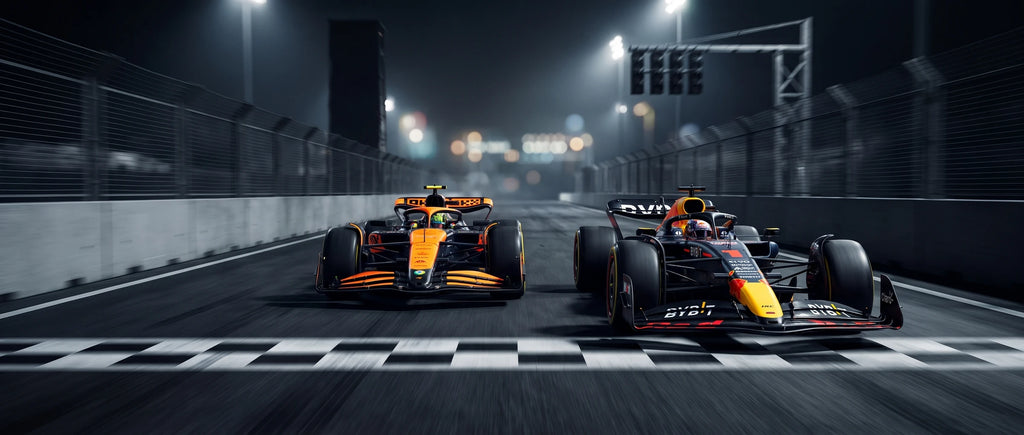
On Saturday night on the Strip, Formula 1 produced exactly the opposite of what was expected. Instead of a race where the best-balanced car escapes, there were thirty-five lead changes, six drivers in front at one point or another, and six tenths of a second at the line. Max Verstappen wins, for the third time here in four editions.
The pole had already changed hands before the start
In qualifying the fastest time belonged to Kimi Antonelli. He would not start at the front: a five-place grid penalty, for exceeding his allocation of power unit components across the season. Pole passed to Max Verstappen, who had not been quickest.
So the world champion would start sixth, in a car capable of winning. That mismatch between real pace and grid position is what made the race: several fast cars were out of place, and none of them intended to stay there.
Verstappen inherits a pole he did not set, and turns it into a win. Antonelli, quickest all weekend, finishes fourth.
Thirty-five times the lead changed hands
That is the number that sums up the evening. Thirty-five lead changes, and three hundred and fifty-two position changes across the field. Six drivers led at least one lap.
The explanation is what we wrote before the race, turned on its head. The cold and the lack of grip were supposed to blow the gaps apart. Mostly they stopped cars from holding their tyres in the right window for more than a few laps at a time. Each one warmed up, attacked, chewed through the tyres, dropped back, then started again. Hence the constant swapping.
Add the two-kilometre straight, where the tow is strong enough that taking back a lost place costs less than it would elsewhere. A race where overtaking is easy is a race where nobody controls anything.
Both Mercedes attack, the wall settles it
For a good part of the race Verstappen was not racing McLaren but the two Mercedes. George Russell and Antonelli came back at him in turn, put a nose alongside, backed out. He held off one attack after another.
Then Russell went too far. At Turn 5, on lap 48, he arrived long, locked up and hit the barrier. His race for the win ended there. He was classified ninth, with two points. Antonelli lost his rhythm in the closing laps and finished fourth, 2.574s back.

For the team the evening is bitter: the fastest car on the grid came away with fourth place and two points.
Piastri: seventeenth on the grid, third at the flag
The drive of the night was not the winner's. Oscar Piastri started seventeenth and finished on the podium, 1.529s behind. Fourteen places gained.
Ahead of him, Lando Norris finished second by six tenths, having spent the end of the race in Verstappen's tow without ever finding a way past. McLaren leaves with a double podium and thirty-three points against Red Bull's twenty-five, which matters a great deal for what follows.

Ferrari: two ten-second penalties
Maranello's evening comes down to two identical sanctions. Lewis Hamilton took ten seconds for leaving the track and gaining an advantage, during an early fight for seventh. He finished seventh anyway, with six points.
Charles Leclerc also took ten seconds, this time for a collision with his own team mate. He finished tenth and scored a single point. The two Ferraris touched each other, again.
In the championship the consequence is clear: Leclerc drops to sixth, fourteen points behind Norris.
The standings before Qatar
The drivers' title was settled in Mexico and Mercedes sealed the constructors' in Brazil. What is left reads in two lines.
Second place. Verstappen has 304 points against Hamilton's 267. Thirty-seven clear with fifty still available: not done, but it would take a double retirement.
Third place. That is where it tightens. Hamilton 267, Russell and Norris level on 264, Leclerc 250. Four drivers inside seventeen points for a step on the championship podium.
Among the constructors, Mercedes end on 666 points ahead of Ferrari on 517, and Red Bull lead McLaren 440 to 431 for third. The whole grid sits in the Formula 1 world.
Two races remain: Qatar from 27 to 29 November, then Abu Dhabi from 4 to 6 December. Neither is a sprint weekend.
Three pieces after Las Vegas
The winner, and the two McLarens that followed him across the line.


Frequently asked questions
Who won the 2026 Las Vegas Grand Prix?
Max Verstappen, from pole, by 0.639s over Lando Norris. Oscar Piastri completed the podium 1.529s back. It is Verstappen's third win at this Grand Prix in four editions.
Why was Antonelli not on pole?
He had set the fastest time in qualifying, but a five-place grid penalty for exceeding his power unit component allocation pushed him back. He finished fourth.
What happened to George Russell?
He was fighting for the win when he arrived too long at Turn 5 on lap 48 and hit the barrier. He was classified ninth with two points.
Why were both Ferraris penalised?
Ten seconds each. Lewis Hamilton for leaving the track and gaining an advantage, Charles Leclerc for a collision with his team mate. They finished seventh and tenth.
Which races are left in 2026?
Two: Qatar from 27 to 29 November and Abu Dhabi from 4 to 6 December. Neither is a sprint weekend, so fifty points remain available.